What is Instructional Coaching?
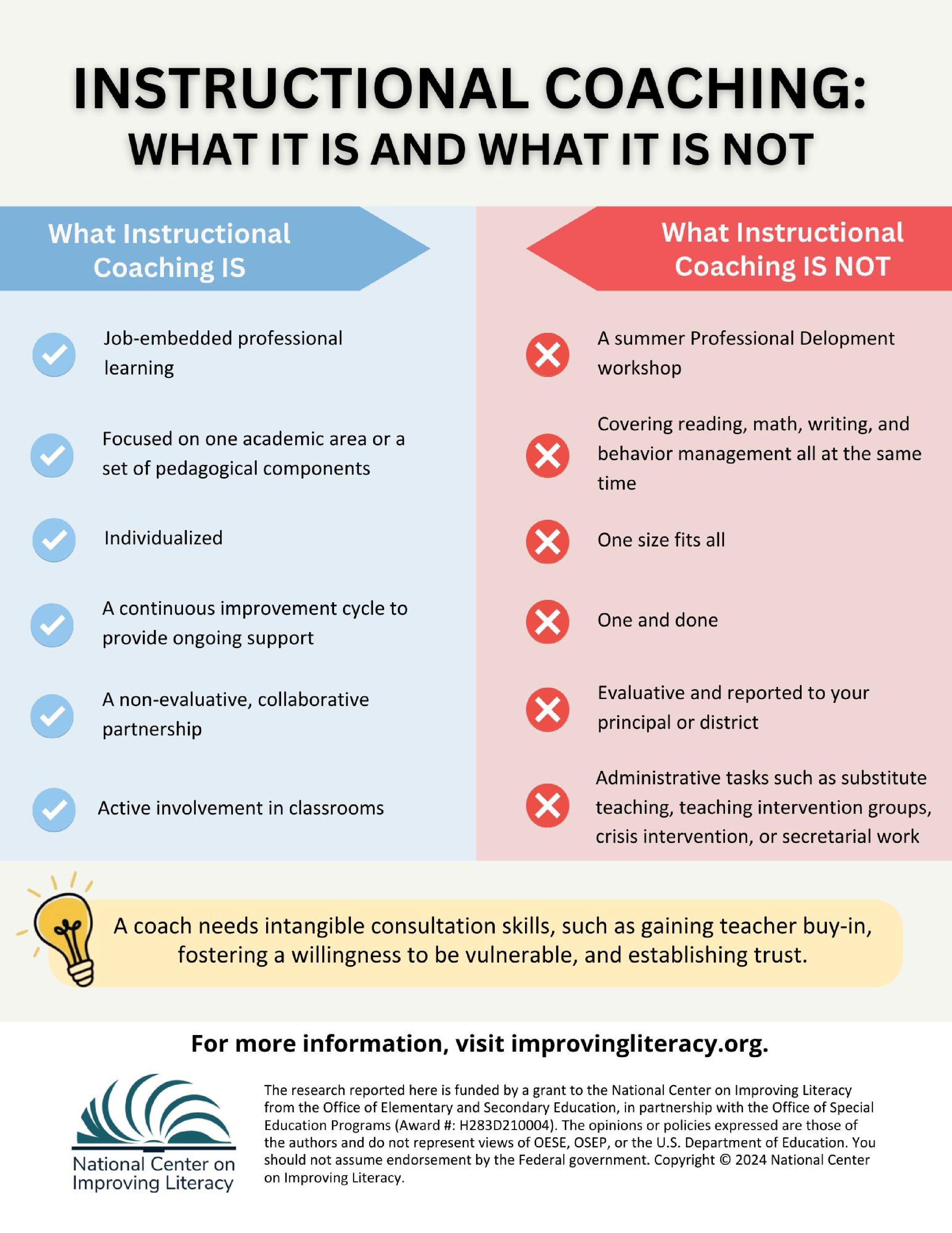
Instructional coaching is a type of professional development that is distinct from typical ‘one and done’ training. It is often delivered at the individual-level, involves a long-term relationship between the coach and teacher, and is embedded within a teacher’s specific classroom (Knight, 2009; Kraft et al., 2018). The purpose of instructional coaching is to improve the implementation of evidence-based practices in classrooms (Garbacz et al., 2017.)
Decades of research evaluating the effectiveness of professional development suggest that school or district-wide trainings without follow-up support are ineffective in changing teacher behavior or student outcomes (Desimone, 2009; Garbacz et al., 2015; Kraft et al., 2018). While these trainings may build teacher content knowledge, this rarely translates to the classroom or positively impacts students (Harn et al., 2013). Instead, it is instructional coaching that builds both teacher knowledge and pedagogical skill to improve student outcomes.
What Are Features of Effective Instructional Coaching?
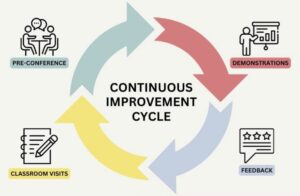
Instructional coaching is most effective when it is focused on one specific area, such as reading instruction. It occurs through a continuous improvement cycle, which may include a pre-conference, demonstration or model lesson, classroom visit, and feedback with goal setting (Knight, 2009).
Effective instructional coaching typically involves observing instruction and providing feedback. Feedback may be in-the-moment/in-vivo or delayed, and may be presented orally or written, remote or in-person. Feedback often occurs over an extended period within the continuous improvement cycle (Knight, 2009).
Coaches provide feedback to shape teacher behavior to improve student outcomes. This is distinctly different than the type of classroom visit or feedback that an administrator may provide for evaluation or teacher tenure decisions. While feedback is critical to effective coaching, it must be non-evaluative.
It can also be helpful to elicit teacher feedback after training and coaching and provide opportunities for goal setting (Knight, 2009). Instructional coaching also involves more difficult to measure intangible components such as gaining teacher buy-in, fostering a willingness to be vulnerable, and establishing trust.
Why is Instructional Coaching Important?
Decades of research on evidence-based practice demonstrate the positive relationship between implementation of evidence-based reading interventions and improved student outcomes (Baker et al., 2010). More recent research has better operationalized how to measure teacher implementation of evidence-based practice (Vaughn et al., 2012). It is hypothesized that follow-up support from instructional coaches may be an active ingredient in carrying out evidence-based practices in classrooms. Ongoing job-embedded professional development is critical to strengthening the use of evidence-based instructional practices and improving student outcomes.