
Reading instruction should help children develop the skills they need to recognize words, understand how letters connect to sounds, and become successful readers. However, some approaches may appear helpful or engaging without building the underlying skills children need. Understanding what effective instruction looks like can help families recognize practices that support reading development and those that may be less effective.
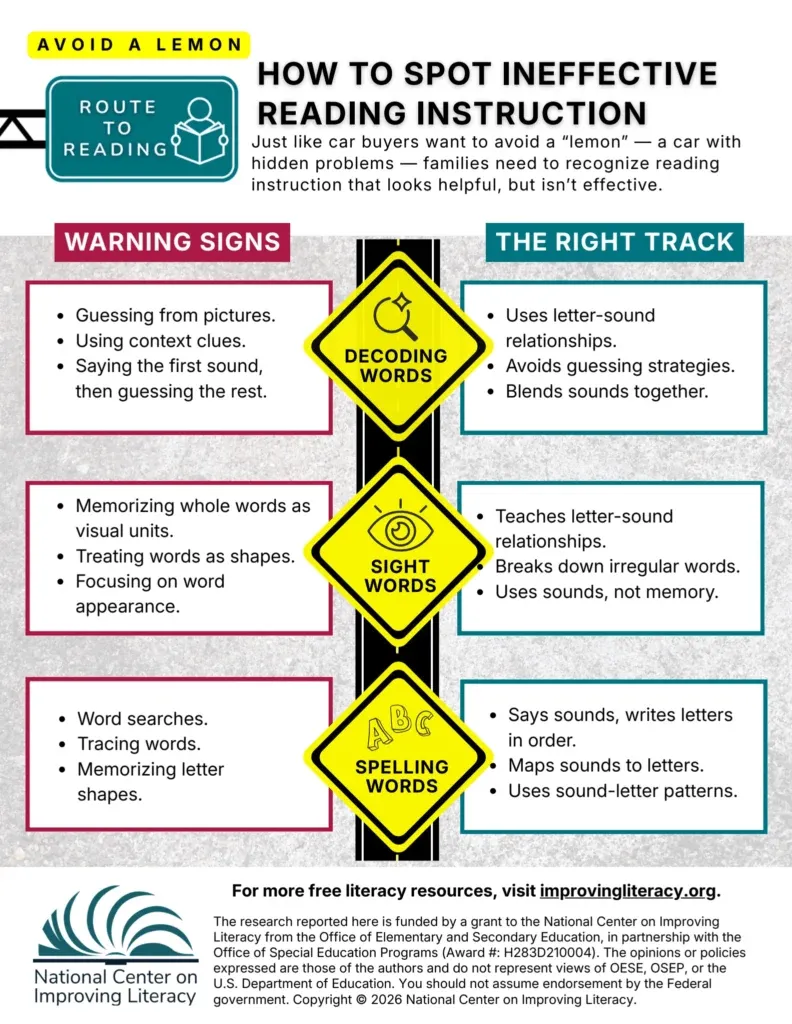
One important skill is decoding, which involves using knowledge of letters and their corresponding sounds to read unfamiliar words. Effective decoding instruction teaches children to look carefully at the letters in a word and blend the sounds together. Strategies that encourage children to guess words based on pictures, context clues, or only the first letter do not build the decoding skills needed for strong reading. Instead, children need opportunities to apply letter-sound relationships when reading unfamiliar words.
Another important area is sight word instruction. Sight words are words children recognize instantly, whether they follow regular spelling patterns or contain irregular letter-sound relationships. A common misconception is that children learn these words by memorizing their overall appearance. However, effective instruction helps children connect speech sounds with letters and recognize the order of letters within words. Even words with irregular spellings can be taught by identifying the parts that follow familiar patterns and focusing on the portions that do not.
Spelling instruction also relies on understanding the relationship between sounds and letters. Activities such as word searches, tracing words, or memorizing letter shapes may seem engaging, but they do not develop the underlying skills children need for spelling. Effective spelling instruction teaches children to identify the sounds in spoken words and represent those sounds with letters or letter patterns in the correct order. This reinforces the same sound-letter knowledge that supports reading.
Families can use this understanding to ask questions about how decoding, sight words, and spelling are being taught at school. Looking for instruction that emphasizes sounds, letters, and spelling patterns rather than guessing or visual memorization can help families better understand whether their child is receiving effective reading instruction.
Recognizing these differences is an important part of supporting children’s literacy development and working with educators to ensure that instruction builds the skills needed for reading and writing.
Explore the Route to Reading Series
Explore all 10 infographics in the Route to Reading series, along with the complete family guide.
Explore the Complete Series