

Free Evidence-Based Resources for Literacy Success | Funded by the U.S. Department of Education

Boosting Early Literacy Through Content-Rich Instruction

National Center on Improving Literacy

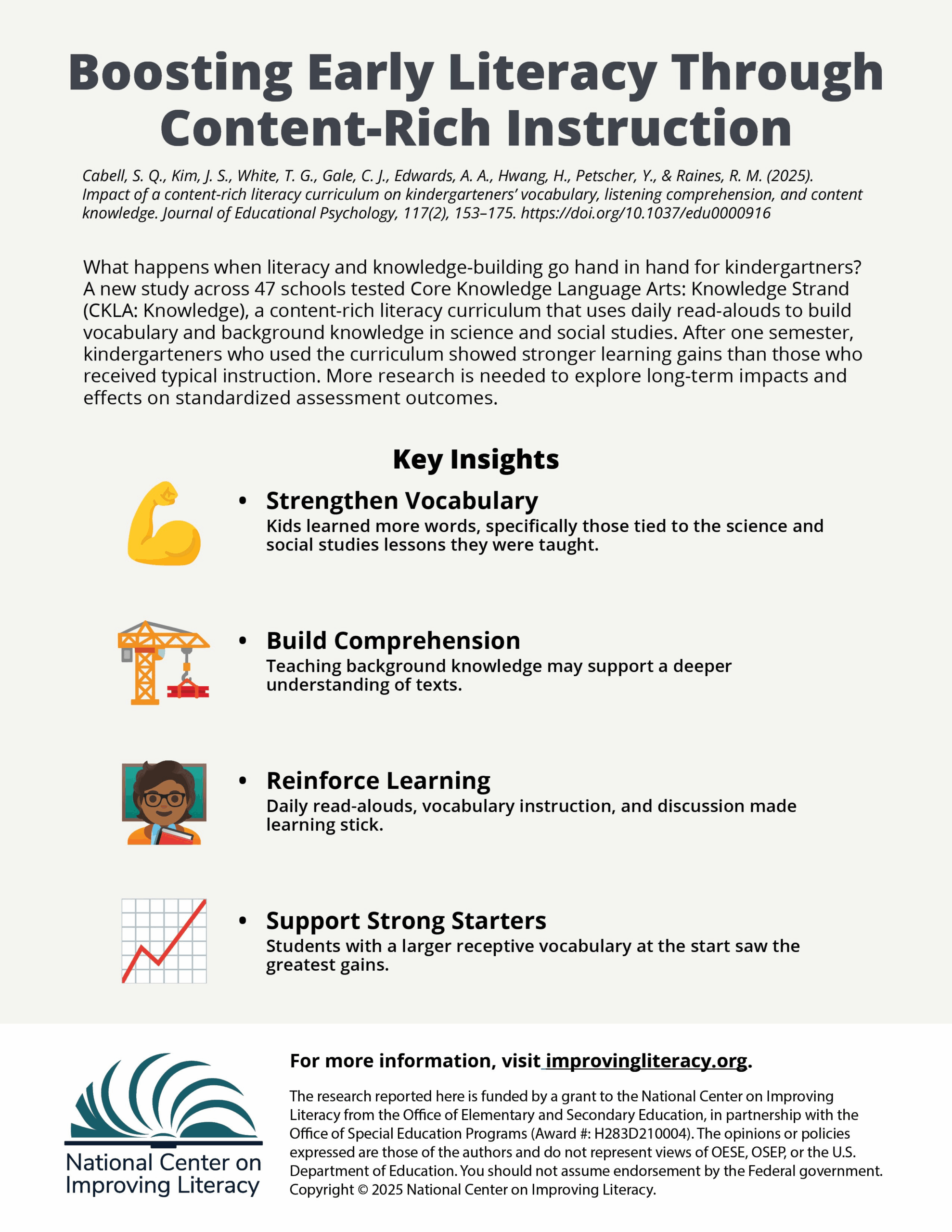
A new study explores how integrating a content-rich approach to early literacy instruction can accelerate learning in kindergarten. This infographic highlights key findings from a curriculum that uses science and social studies to build vocabulary and comprehension.

A book and a green apple resting on table

What happens when literacy and knowledge-building go hand in hand for kindergartners? 

A new study across 47 schools tested Core Knowledge Language Arts: Knowledge Strand (CKLA: Knowledge), a content-rich literacy curriculum that uses daily read-alouds to build vocabulary and background knowledge in science and social studies. After one semester, kindergartners who used the curriculum showed stronger learning gains than those who received typical instruction. More research is needed to explore long-term impacts and effects on standardized assessment outcomes.

Key Insights:

  • Strengthen Vocabulary
    Kids learned more words, specifically those tied to the science and social studies lessons they were taught.

  • Build Comprehension
    Teaching background knowledge may support a deeper understanding of texts.

  • Reinforce Learning
    Daily read-alouds, vocabulary instruction, and discussion made learning stick.

  • Support Strong Starters
    Students with a larger receptive vocabulary at the start saw the greatest gains.
Suggested Citation

National Center on Improving Literacy. (2025). Boosting Early Literacy Through Content-Rich Instruction. https://www.improvingliteracy.org/resource/boosting-early-literacy-through-content-rich-instruction

References

Cabell, S. Q., Kim, J. S., White, T. G., Gale, C. J., Edwards, A. A., Hwang, H., Petscher, Y., & Raines, R. M. (2025). Impact of a content-rich literacy curriculum on kindergarteners’ vocabulary, listening comprehension, and content knowledge. Journal of Educational Psychology, 117(2), 153–175. https://doi.org/10.1037/edu0000916

Related Articles