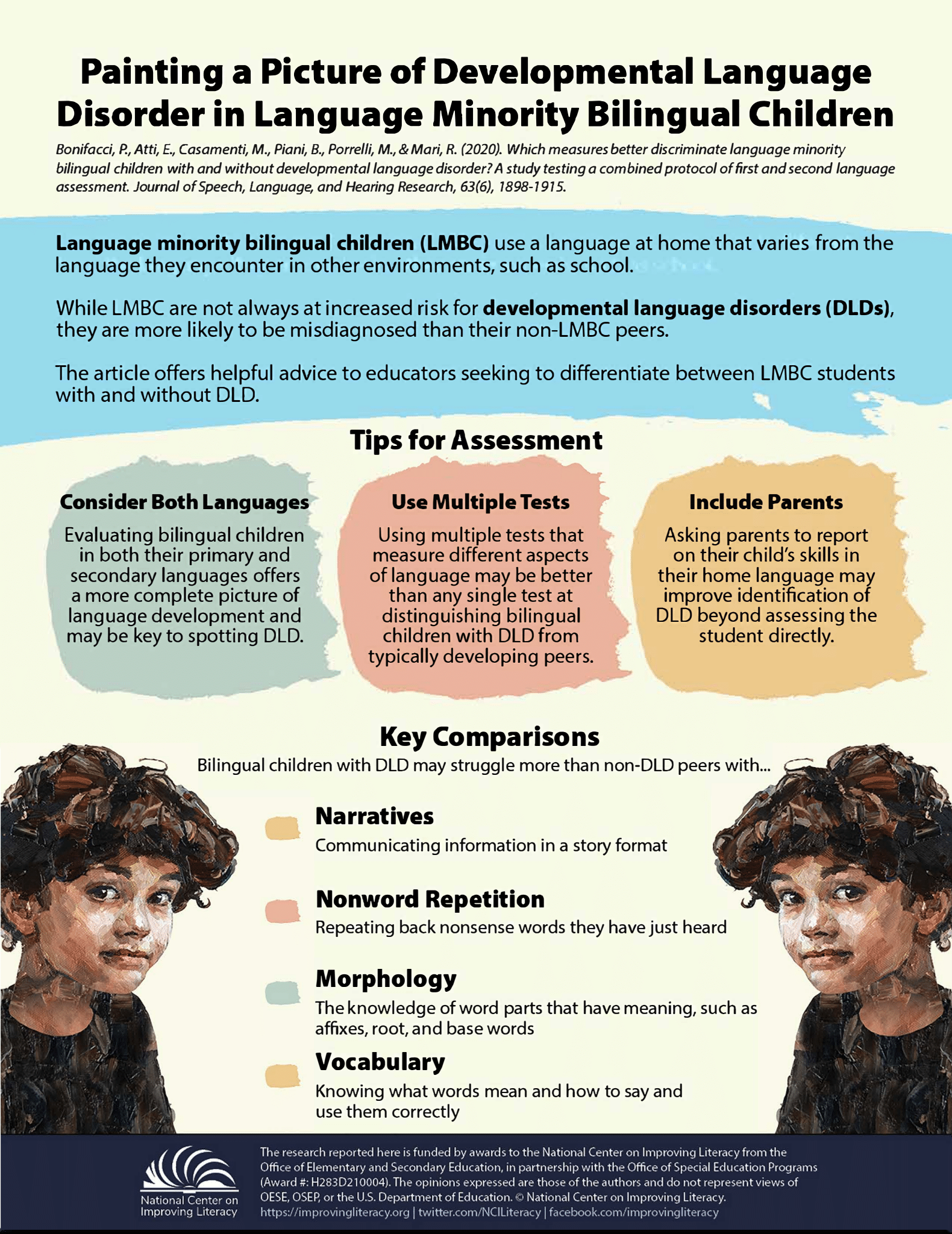

Tips for Assessment:
-
Consider Both – Evaluating bilingual children in both their primary and secondary languages offers a more complete picture of language development and may be key to spotting DLD.
-
Use Multiple Tests – Using multiple tests that measure different aspects of language may be better than any single test at distinguishing bilingual children with DLD from typically developing peers.
-
Include Parents – Asking parents to report on their child’s skills in their home language may improve identification of DLD beyond assessing the student directly.
Key Comparisons:
Bilingual children with DLD may struggle more than non-DLD peers with…
-
Narratives – Communicating information in a story format.
-
Nonword Repetition – Repeating back nonsense words they have just heard.
-
Morphology – The knowledge of word parts that have meaning, such as affixes, root, and base words.
-
Vocabulary – Knowing what words mean and how to say and use them correctly.