
Dynamic Assessment
-
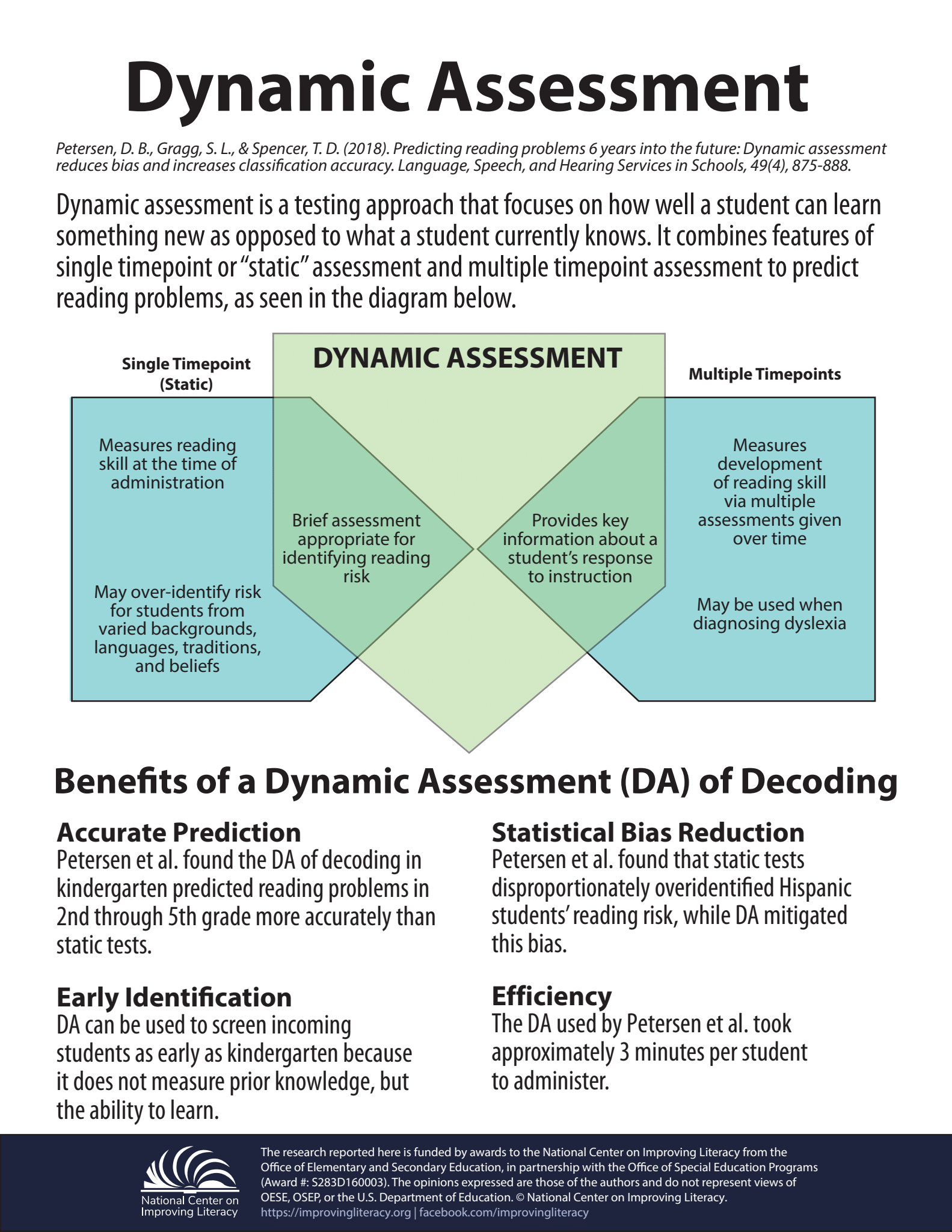
Brief assessment appropriate for identifying reading risk.
-
Provides key information about a student’s response to instruction.
Single Timepoint (Static)
-
Measures reading skill at the time of administration.
-
May over-identify risk for students from varied backgrounds, languages, traditions, and beliefs.
Multiple Timepoints
-
Measures development of reading skill via multiple assessments given over time.
-
May be used when diagnosing dyslexia.
Benefits of a Dynamic Assessment (DA) of Decoding:
-
Accurate Prediction
Petersen et al. found the DA of decoding in kindergarten predicted reading problems in 2nd through 5th grade more accurately than static tests. -
Statistical Bias Reduction
DA can be used to screen incoming students as early as kindergarten because it does not measure prior knowledge, but the ability to learn. -
Early Identification
Petersen et al. found that static tests disproportionately overidentified Hispanic students’ reading risk, while DA mitigated this bias. -
Efficiency
The DA used by Petersen et al. took approximately 3 minutes per student to administer.