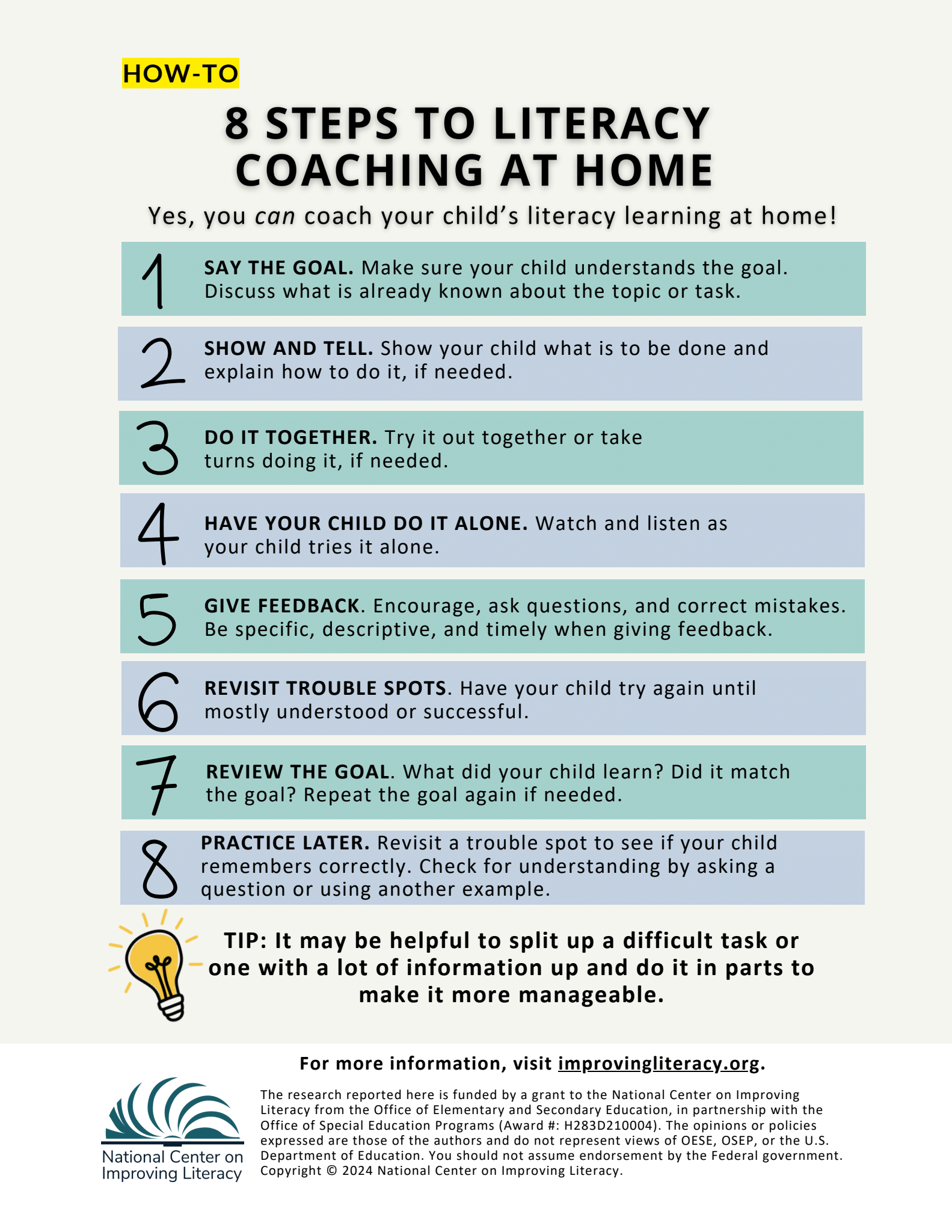
1. Say the Goal
What’s the big idea your child needs to learn? Does your child understand the goal? Discuss what is already known about the topic or task.
2. Show and Tell
Show your child what is to be done and explain how to do it, if needed.
3. Do It Together
Try it out together or take turns doing it, if needed.
4. Do It Alone
Watch and listen as your child tries it alone.
5. Give Feedback
Encourage your child, ask questions to guide learning, and help correct mistakes. The best type of feedback is specific, descriptive, ongoing, and timely. It tells your child what he or she did or did not do in light of the goal.
6. Check Tricky Spots
Go back to trouble areas and have your child try it again until mostly understood or successful.
7. Review the Goal
What did your child learn? Did it match the goal? Say the goal again if needed.
8. Practice Later
Come back to it later to see if your child remembers. Check for understanding by asking a question or trying another example.
You may need to:
-
Break It down
Split a difficult task or lots of information up and do it in parts to make it more manageable.
-
Talk It out
Talking about things before, during, or after learning helps your child to process new ideas or information. Think about the places that might be difficult for your child and talk about it beforehand. Stop after key learning points and discuss before moving on.
-
Give More Examples
Think of other examples to help your child practice. Use pictures, objects, or life connections to make it real.
-
Build It Up
Start with the easier parts and work up to the harder parts to control the level of difficulty.
-
Think Aloud
When you show your thinking, it helps your child see how to tackle problems and answer questions. Say, “I see that….” “First, I look for…” “I think about…” “I try to…” “While I read, I…”